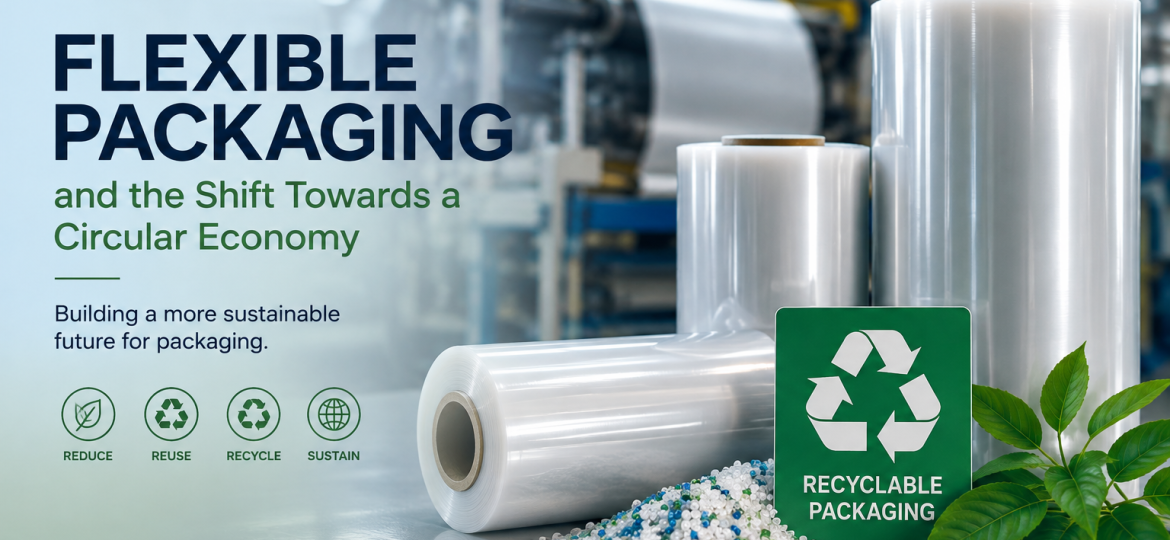
Flexible packaging is entering a new phase in South Africa. Across the industry, recyclability, recycled content, material performance and raw-material economics are becoming increasingly important considerations for manufacturers, converters, brand owners and retailers.
The market is moving towards packaging solutions that are not only functional and cost-effective, but also designed with the wider circular economy in mind.
For PembaFlex, this creates an opportunity to turn these industry developments into practical product development, manufacturing and quality-control initiatives.
1. Flexible Packaging Is Now a Specific South African Circular-Economy Target
What has changed?
The South African Plastics Pact launched its 2030 targets in June 2026, including a specific target for 70% of flexible plastic packaging to be designed for recyclability, alongside a 20% reduction in virgin fossil-fuel-based packaging and a 55% output recycling rate.
These targets represent an important development for the South African flexible packaging industry and highlight the increasing focus on circularity and recyclability.
Why does it matter?
Recyclability is moving from being primarily a sustainability preference towards becoming an increasingly important commercial specification.
Brand owners and retailers are likely to place greater pressure on converters to provide packaging structures that support recycling, including greater consideration of mono-material PE and PP structures and a move away from difficult-to-recycle laminates.
For flexible packaging manufacturers, understanding the recyclability of existing structures will therefore become increasingly important.
A practical approach to recyclability
PembaFlex can begin by auditing its highest-volume flexible packaging structures and classifying them into three categories:
READY
Structures that are already compatible with established recycling streams.
CONVERTIBLE
Structures that are technically capable of moving towards a mono-material structure while maintaining the required performance.
PROBLEMATIC
Structures that depend on PET/PE, foil or other difficult-to-recycle combinations.
This approach provides management with a practical conversion pipeline rather than treating sustainability as a vague future objective.
South African Plastics Pact 2030 Targets
| 70% | 20% | 55% |
|---|---|---|
| Flexible plastic packaging designed for recyclability | Reduction in virgin fossil-fuel-based packaging | Output recycling rate |
2. The New South African Recycling-Label Guide Is Now in Force
What has changed?
The updated South African Plastics Pact On-Pack Recycling Label Visual Guide is valid from August 2026 and is intended to align disposal messaging with actual South African recyclability.
As packaging structures evolve, accurate communication about how packaging should be disposed of will become increasingly important.
Why does it matter?
Artwork approval is becoming part of technical compliance.
A packaging structure may be technically sound, but an incorrect recycling claim or disposal message can still create problems for customers and other stakeholders.
This means recyclability should not only be considered during material selection and product development. It should also be reflected in the artwork and approval process.
What should PembaFlex consider?
The updated OPRL guide should be incorporated into the artwork and job-card approval process.
Sales teams should avoid promising recyclability before the technical team has confirmed the packaging structure and the appropriate disposal route.
This creates a clearer link between:
Material Structure → Technical Assessment → Artwork → Recycling Communication
The result is a more controlled and consistent approach to communicating recyclability to customers.
Updated SA OPRL Visual Guide
3. Mono-PE Is Becoming More Achievable Without Exotic Equipment
What has changed?
Developments in flexible packaging technology are making recyclable mono-material structures increasingly achievable.
A July 2026 development from ExxonMobil and Bandera demonstrated an all-PE pet-food pouch using conventional blown-film extrusion rather than requiring MDO equipment.
The partners reported that the structure can achieve the stiffness, clarity and barrier performance required for demanding packaging applications.
A parallel development from Walki and Dow uses MDO-PE together with low-temperature sealing technology to create recyclable mono-PE pouches with a premium matte finish.
Why does it matter?
The technology landscape for recyclable flexible packaging is widening.
For manufacturers such as PembaFlex, this means that developing recyclable structures does not necessarily require an immediate move into expensive MDO investment.
Instead, conventional blown-film technology can potentially provide a starting point for controlled development and testing of mono-PE structures.
What should PembaFlex investigate?
PembaFlex can approach material suppliers for commercial samples and processing windows for conventional blown-film mono-PE structures.
These materials should then be evaluated against existing products and manufacturing requirements.
Key trial criteria should include:
- Seal strength and hot tack
- Coefficient of friction (COF)
- Puncture and tear resistance
- Print adhesion
- Barrier performance
- Machine speed
- Finished-pack performance
A controlled trial of this nature would allow PembaFlex to evaluate the practical potential of mono-PE structures before making significant capital-investment decisions.
4. Raw-Material Price Volatility Deserves Purchasing Attention
What has changed?
Raw-material pricing remains an important consideration for the flexible packaging industry.
Flexible Packaging Europe data reported substantial Q2 increases across key flexible-packaging substrates, including approximately:
31% for LDPE
38% for HDPE
40% for PET film
97% for BOPP
These increases were reported compared with Q1.
Recent August polymer-market data has also shown further increases in several LLDPE film grades in major Asian markets.
Why does it matter?
Local supplier prices will not necessarily move in exactly the same proportion as international market prices.
However, imported resin exposure, freight costs, exchange rates and supplier lead times can all affect the final cost of materials and place pressure on manufacturing margins.
For flexible packaging manufacturers, effective raw-material monitoring is therefore an important part of maintaining commercial control.
A practical approach to raw-material management
For every major raw material, PembaFlex should track:
Opening Stock → Orders Outstanding → Supplier Price → Landed Cost → Jobs Committed → Projected Closing Stock
This provides a clearer picture of both current stock exposure and future material requirements.
Customer quotations should also be considered carefully where raw-material prices are volatile.
In particular, long-validity customer prices should ideally include an explicit resin-price assumption.
5. High-PCR PE Film Is Becoming Technically Credible
What has changed?
High-PCR PE films are becoming increasingly technically credible for flexible packaging applications.
A 2026 flexographic technology demonstration reported successful printing on transparent PE films containing more than 90% post-consumer recycled content, including premium graphics.
This demonstrates the potential for recycled-content films to move beyond the traditional perception of recycled packaging as having limited visual or performance appeal.
Why does it matter?
The key challenges associated with high-PCR films increasingly extend beyond printability.
Factors such as:
- Material consistency
- Contamination
- Odour
- Mechanical properties
- Process control
can all influence the suitability and performance of high-PCR materials.
For manufacturers, this means that recycled content needs to be evaluated as a complete material and manufacturing consideration rather than simply as a sustainability claim.
What should PembaFlex investigate?
PembaFlex should not rush directly into high-PCR production.
Instead, suppliers should be asked to provide information on:
- PCR percentage and certification
- Melt-flow consistency
- Contamination specification
- Film gauge tolerance
- Tensile and elongation data
- Odour information
- Food-contact status, where relevant
Once the material characteristics have been established, PembaFlex can identify one suitable non-food-contact application where a controlled PCR trial could be conducted with relatively low commercial risk.
PembaFlex Priorities for This Week
The developments above can be translated into five practical priorities for PembaFlex.
1. Recyclability Audit
Map the highest-volume flexible-film products against the new South African 70%-by-2030 direction and classify structures as Ready, Convertible or Problematic.
2. Mono-PE Trial
Select one realistic existing product and begin a supplier and sample trial to investigate a recyclable mono-PE structure.
3. Raw-Material Dashboard
Bring resin prices, landed costs and stock cover into one weekly management sheet to improve visibility over material costs and inventory.
4. Artwork Control
Implement the August 2026 OPRL guide into the artwork and job-card approval process.
5. PCR Investigation
Identify one suitable non-food-contact product for a controlled high-PCR PE feasibility trial.
Looking Ahead
The important shift is not one new machine or one new resin.
The flexible packaging industry is increasingly converging around recyclable structures, recycled content, documented material performance and tighter control of raw-material economics.
For PembaFlex, the opportunity is to start converting these industry trends into specific products, controlled trials and factory processes now — before customers turn these emerging requirements into urgent specifications.